
Does a $200 Amplifier Sound Better than a $1,000 Bryston?
Hold on tight, here’s the results of an experiment that I did back in the summer of 2000 with two amplifiers. What does this have to do with reel to reel tape decks? Well, nothing, but every RTR needs to run through an amplifier, so it counts.
Plus, the internet has a million opinions about ‘what amp sounds the best’, so I thought I’d throw in my 2 cents for your consideration.
The back story
Some time in late 1999, the sound company I used to own did a renovation of a pub sound system in Squamish BC. As we were wrapping up, the owner said ‘hey, there’s a defunct night club around the back of the building, and there’s a rack of amps in there that you guys can have if you want them’ We head into the dingy club that reeked of beer and stale cigarettes from the 1980s, and sure enough, there was an amp rack that had four ‘Dialectric’ amps in it. The Dialectric amps were the original Bryston 3B series, and a local company had put a thin 18 gauge piece of aluminum over the Bryston panel, with their Dialectric company name on it.
For those not in the know, Bryston is a well known consumer and pro audio company, and the 2B, 3B and 4B amplifiers were exceptionally popular in the 1990s and 90s. Bryston is known for their customer service, and their 20 year warranty on the amps (that warranty was recently reduced to 10 years as of 2025). According to the warranty, at any point in time, you could box up the amplifier, send it to Bryston, and they’d repair it at no charge. The catch of course was that Bryston was based in Toronto, and if you could live without your amp for 1 or 2 months, that was fine. Touring bands however couldn’t wait, so the repair shop I owned back in the early 1990s got these amps in regularly for repair.
The amps were well built, and when purchased, each one came with a handwritten spec sheet, specific to that amplifier, which was then signed off by whatever tech did the measurements. Some of the models were dual mono construction, so that the only thing common to each channel was the power cord, power switch and main fuse. The circuit design was class AB, a pretty straightforward power amplifier design, and in the case of the 3B, was rated at 100 watts continuous into 8 ohms per channel. The amp was very basic, two trimpot level controls on the back, either RCA or ¼ phone inputs, and 5 way binding posts for the output. There were two clip lights on the front of the amp, indicating when max power was reached.
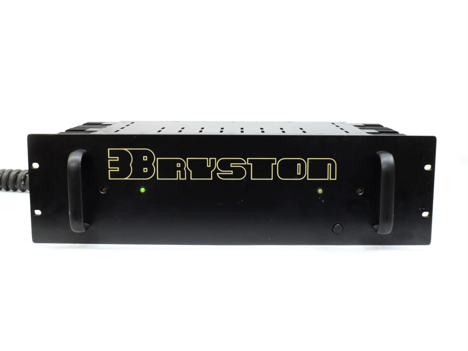
The first generation of Bryston 3B power amplifier
The Bryston amp had a retail price back then of $1,600 CDN, around $1,200 US. With the amount of Brystons that my shop repaired, I found them to be nothing special, but they sounded good, and were generally reliable. I also figured that about 30% of the purchase price was delegated to that 20 year warranty, so that Bryston wouldn’t lose their shirts repairing amps that were close to the end of their 20 year warranty period. Independent shops like my company, were doing Bryston a favor, as we were charging our clients for work that Bryston would have done at no charge, so the 30% surcharge to cover the warranty was just pocketed by Bryston.
So, the Bryston 3Bs we received were pretty sad looking. They were covered in layers of nicotine from the night club, and were dusty and dirty. I gave two to my sales guy that had landed the pub sound system sale, and I got the other two. I bench tested my two, and using the same Soundtech 1700B amplifier analyzer (power and distortion measurements’) that I use today, I found that despite the grime, both worked fine, and were still in spec. I ran them for a few hours to make sure they ran well, and sold each one on eBay.
My sales guy decided to keep his two, and called Bryston with the serial numbers to check on the warranty status. Sure enough, there was still 18 months on the warranty on each one, which means they were made in the early 1980s. Bryston said to send them in, and so for around $35 each in shipping costs, off they went to Bryston.
About a month later, Bryston called my sales rep, and said that they would bring the amp to spec, doing all of the 3B circuit modifications that Bryston had come up with since that version of amp was made. Both power switches would be replaced at no charge, and while they were sold out of new front panels, they’d replace his nicotine stained panels with better condition used ones. They recommended changing the main filter capacitors, even though the original ones still checked OK, and they’d send the amps back in an original Bryston shipping box. They’d charge for the filter caps, but not for the labor to install them. My sales guy gave the go-ahead, and for a total of $160 CDN to cover shipping and the non-warranty parts (the main filter caps), he got his two amplifiers back, fully serviced, with a new handwritten spec sheet. Pretty impressive!
When I owned Sound Solutions, my sound installation company, we were selling a ton of a brand called Inter-M. They were a Korean company originally, called Inkel, and they made pro/commercial audio products, from speakers to power amps. I believe the company got sold to new Taiwanese owners, got a quality control overhaul, and the name brand changed to Inter M some time in the early 1990s.
Inter M was also a large OEM, making products for Yamaha, Altec Lansing, and the entire original Samson Audio pro line was just an Inter M product with a Samson name plate on it. The bottom line is, Inter M products were dirt cheap, and for the most part (with a few exceptions), super reliable. We sold the Inter M amplifiers into pubs and restaurants all over BC with great results.
One of the models of amps we sold a lot of was called the REF-2300, later called the R-300. As with the Bryston, it was rated at 100 W continuous into 8 ohms per channel, and was convection cooled. It was also a class AB amplifier, just like the Bryston. Our dealer price was around $225 CDN, or $160 US. We sold them for $299 CDN.
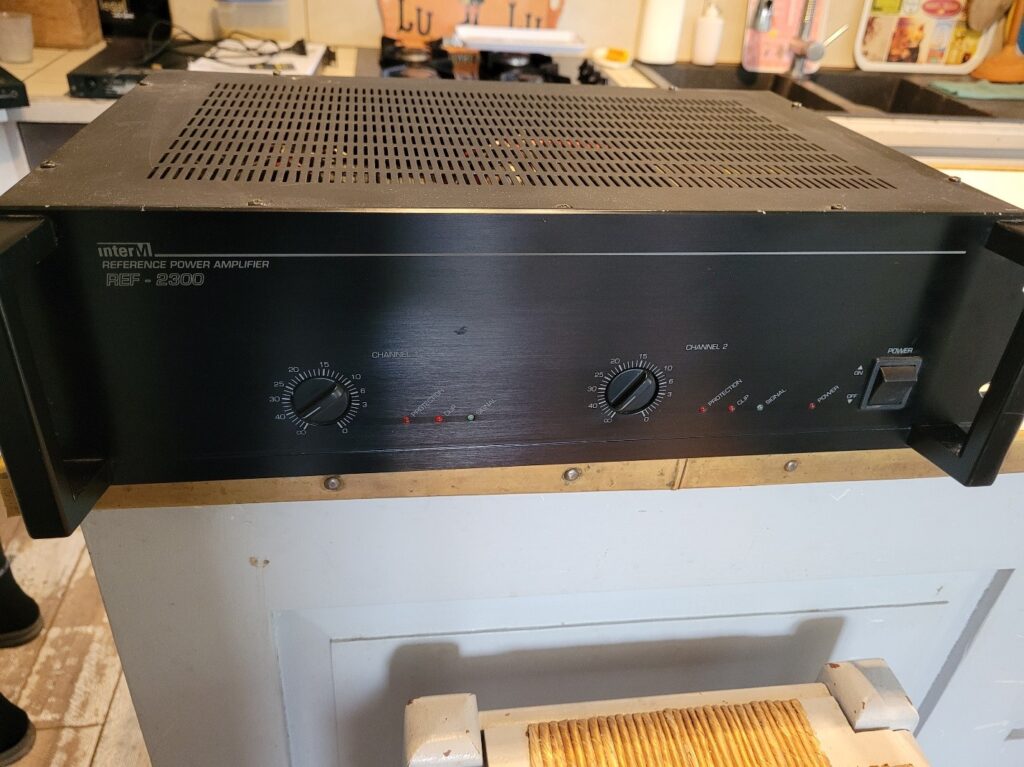
Inter M REF-2300 power amplifier
Once Gordon our sales rep got his Brystons back from service, I had the bright idea to build something I’ve always wanted to do: a relay box that would switch the speaker output from each amplifier to a single pair of speakers, with a remote switch on a 20’ cable, so you could switch instantaneously back and forth between amplifiers, to compare the sound quality.
Gordon laughed at me, saying that the Brystons were a far better amp than the Inter M models, and would sound infinitely better. I wasn’t so sure, but certainly was curious.
So, over a weekend, I put a 20 amp DPDT relay into a project box, and made up a circuit so that a momentary push-button switch would either activate, or deactivate the relay, thus switching the speakers between amplifier outputs. A preamp that I had in my home stereo rack (I can’t remember the make or model for the life of me) drove the input of both amplifiers at the same time, so when pushing the button for the relay, the signal lights on both amplifiers would remain on. This was a true double-blind test between the two amps.
The signal source was a generic single disc Pioneer CD player, just a run of the mill unit, and we had the amps drive a pair of JBL 4311s that I had, a 12” 3 way decent floor mount or bookshelf speaker set.
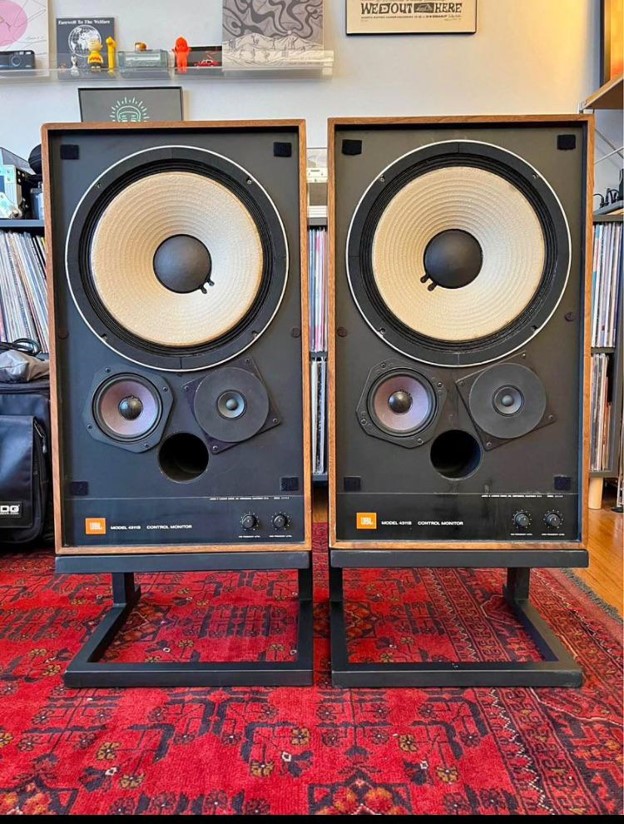
JBL 4311 12” 3 way speakers
Once I verified that the speaker switching relay box worked, I matched the levels of the two amplifier to play at exactly the same volume. I was there, as was Gordon, as was Paul, my bench level technician. We decided to play a male vocal track (Leonard Cohen), female vocal (Madonna), and an instrumental CD (something from the Telarc catalog, I can’t remember what artist or track).
I handed Gordon the push-button switch, and told him to press it as many times as he wanted, until he identified the amplifier that sounded better. At that point, he should stop pressing the button, and we’d turn off one amp to see which one was the winner.
We cued up Madonna, and Gordon said ‘I can’t tell which amp I’m listening to’. I told him that was the whole point, that the only thing that mattered was the sound quality that he perceived to be better. Half way through the Madonna track he admitted ‘this is harder than I thought’, but towards the end of the song, he stopped, and said ‘OK, I think this one sounds better’.
I went up to the amps, and turned off the Bryston. The music kept playing. Score 1 for the Inter-M.
For the second test, we played Leonard Cohen, and that time he picked the Bryston.
So it came down to the instrumental jazz track. We played it to the end, and near the end of the track, Gordon stopped pushing the button. I turned off the Inter-M amp, and the music stopped. Gordon was stunned. Two out of the three times, the $225 Inter M amp bested the $1200 Bryston.
For me personally, I could hear no difference between the two amps. My tech Paul claimed that he thought the sound-stage was better on the Bryston, although he was never in control of the push-button switch.
Conclusion
While this was hardly a definitive test between amplifiers, it certainly was the first time that I had done a completely blind A/B test. My townhouse living room certainly wasn’t tuned, but it was a system that I had lived with for about 5 years, using similar equipment.
As a tech, I will now offend the high end audiophiles by stating that my belief for the most part is:
-two amplifiers with the same power rating (in this case, 100 watts continuous into 8 ohm) will sound very similar, if not identical. The caveat for this of course is:
-both amplifiers are of the same design (class A, class AB, Class D, Class H, etc)
-both amplifiers are running to spec (with the Inter M being new out of the box, and the Bryston being freshly refurbished from Bryston, that certainly was the case here)
-both amps use the same technology (i.e. tube or transistor or output chip)
Recently, I discovered the relay box in my parts warehouse. I’m sure it still works, and I should be able to resurrect it. One day I’ll make up another switch push-button, and I’ll fire the system up again to try the test all over, and with more than one amplifier.
The argument against this double blind test is that ‘the relay contact will color the sound of each amp’. First, I don’t believe that is true, but for those that think the relay contacts will change the sound, then I counter with: Since the contacts are equal for both amps, the sound will be colored equally of both amplifiers, so that change cancels itself out.